
A Step-by-Step Guide for Homeowners
When you bought your rural home, the previous owner may have handed you keys, a deed, and a vague wave toward the backyard saying “the septic’s out there somewhere.” If you’re staring at your property wondering where exactly your septic system is hiding, you’re not alone. Thousands of homeowners inherit properties with zero septic documentation, leaving them guessing about one of their home’s most critical systems.
Why Knowing Your System’s Location Matters
Before we dive into detective work, let’s understand why this matters. Your septic system isn’t just “somewhere underground”—it’s a carefully engineered network of components that need regular maintenance, occasional repairs, and emergency access. Without knowing where everything is located, you’re flying blind when problems arise.
Consider what happened to the Martinez family in rural Oregon. When their basement started flooding with sewage during a holiday gathering, they spent precious hours digging random holes in their yard, desperately searching for their tank. What should have been a quick pump-out turned into a $3,000 emergency because they couldn’t locate their system quickly.
Starting Your Search: Follow the Clues from Inside
Your septic system investigation begins inside your home, not in the yard. Every drain in your house connects to the main sewer line, which leads directly to your septic tank.
Step 1: Locate Your Main Sewer Line Exit Point
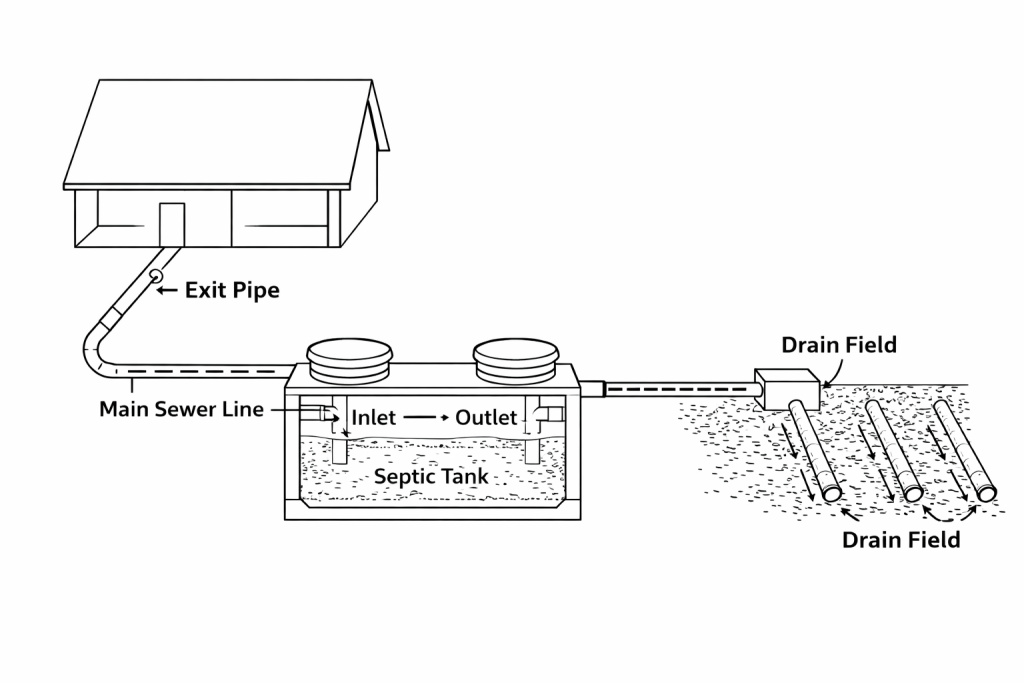
Head to your basement, crawlspace, or the lowest level of your home. Look for the largest pipe (usually 4 inches in diameter) that exits through the foundation wall. This is your main sewer line, and it’s pointing you toward your septic tank.
In many homes, you’ll find this pipe exiting on the side of the house that faces away from the street—septic systems are often installed in the backyard or side yard, away from wells and property lines, though this can vary depending on local codes and site conditions.
Step 2: Follow the Pipe’s Direction
Once you’ve found where the main line exits your house, step outside and note the direction. The septic tank will be somewhere along this line. In many cases, it is located roughly 10–25 feet from the foundation, but this distance can vary significantly depending on local regulations, terrain, and how the system was installed.
Before doing any digging or probing, it’s also worth checking with your local health department or municipality for septic permits, as-built drawings, or inspection records—these can sometimes pinpoint the system location quickly and safely.
Outdoor Detective Work: Reading Your Landscape
Your yard holds numerous clues about what’s buried beneath. Septic systems can leave subtle traces on the surface, though these signs are not always obvious.
Look for These Visual Clues:
Grass Color Variations:
Over septic components, grass may grow differently. It might appear slightly greener due to moisture or nutrients, or sometimes thinner due to soil conditions. However, very lush or bright green patches—especially during dry periods—can also indicate excess moisture or a potential problem rather than a healthy system.
Slight Depressions or Raised Areas:
Settling soil over the tank can create subtle depressions. Conversely, if the tank was installed with excess backfill, you might see a slightly raised rectangular area.
Vegetation Patterns:
Plants over the drain field may grow differently due to moisture levels. Look for faint linear patterns that could indicate buried pipes, though these are often subtle.

The Probe Method: Gentle Underground Exploration
If visual clues aren’t giving you clear answers, careful probing may help—but it should be done cautiously.
What You’ll Need:
- A thin metal probe (such as a long screwdriver or piece of rebar)
- Spray paint or flags to mark your findings
- A measuring tape
- Patience
The Probing Process:
Starting about 10 feet from where your sewer line exits the house, begin probing the ground every 2–3 feet in a grid pattern. Push the probe straight down—you’re looking for a change in resistance that may indicate contact with a solid surface such as a tank.
Most septic tanks are rectangular, typically 8–12 feet long and 4–6 feet wide. When you find one edge, probe around to outline the entire tank and mark the corners.
Important Safety Note:
Probe gently and avoid using excessive force. Never probe aggressively near the suspected center of a tank, where lids or weaker surfaces may be located. Older tanks, lids, or pipes can be fragile and may be damaged by probing. If you encounter strong resistance or are unsure, stop and consider using a professional locator.
Advanced Techniques for Stubborn Systems
If basic probing isn’t working, these methods may help—but results can vary depending on soil conditions and system design.
The Water Test Method
This technique works best with a helper but is not always reliable:
- Have someone inside the house run water continuously (for example, using a hose into a drain)
- Use a probe or metal rod to listen or feel for subtle vibrations or sound changes underground
- Attempt to follow the general direction from your house toward the tank
Note: In many soil types, especially dense or clay soils, this method may produce little to no detectable signal, so it should be considered a supplemental technique rather than a primary one.
Checking for Risers or Access Points
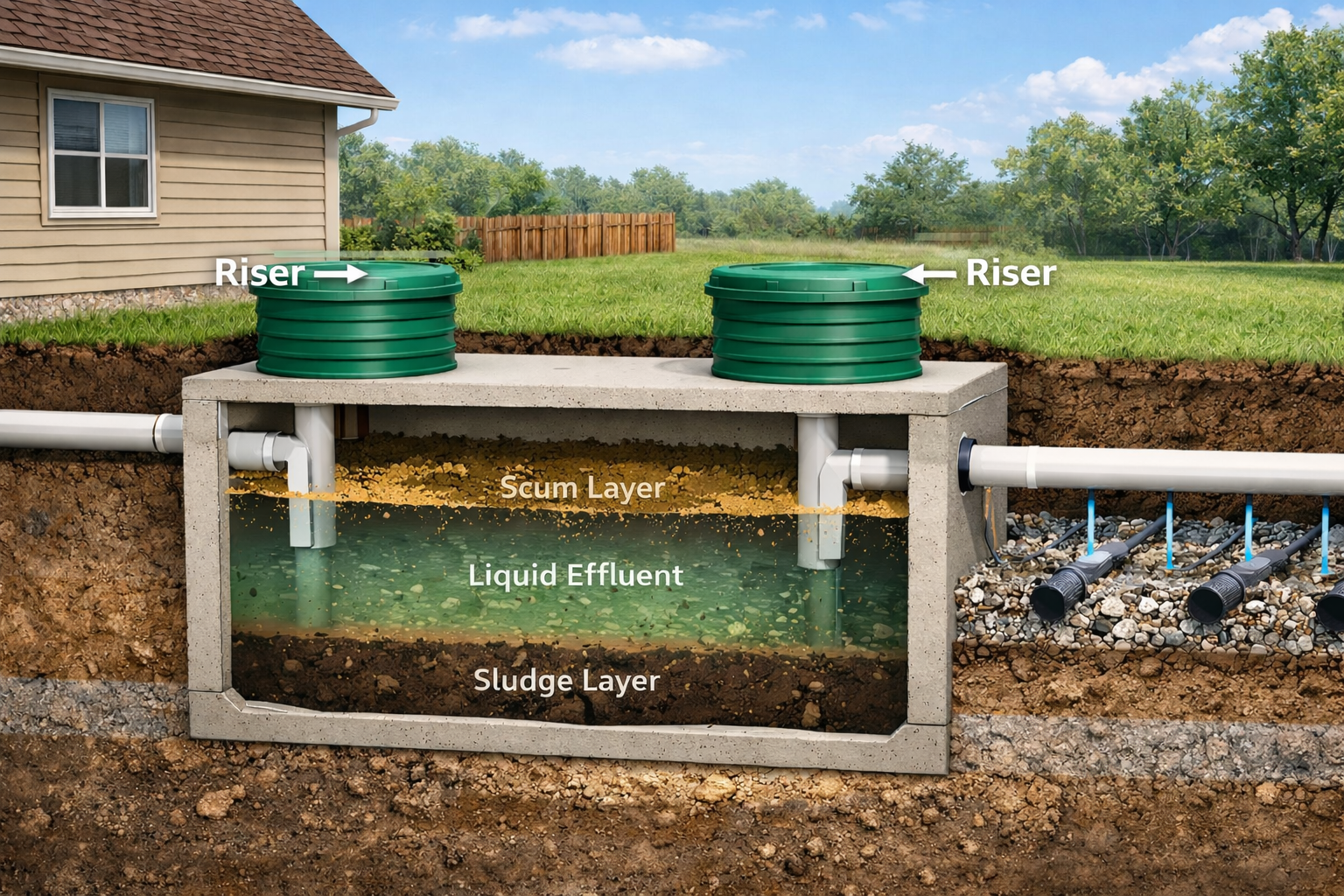
Many newer systems (and some retrofitted older ones) have risers—pipes that extend from the tank to ground level for easy access. These might be covered by:
- Plastic or concrete lids at ground level
- Decorative rocks or landscaping features
- Overgrown vegetation
Walk your property looking for any circular covers, unusual landscaping features, or areas where the ground appears to have been previously disturbed.

Mapping Your Complete System
Finding the tank is just the beginning. A complete septic system includes several components you’ll want to locate and map.
Components to Find and Mark:
Distribution Box (D-Box):
Often located a short distance from the tank’s outlet side, though the exact placement can vary widely depending on the system design. Some systems may use alternative distribution methods instead of a traditional D-box.
Drain Field Lines:
These perforated pipes extend from the distribution point in parallel lines. They are commonly buried roughly 18–36 inches underground, but depth can vary significantly depending on soil conditions and system type, with some systems installed much shallower or deeper.
Pump Chamber:
If your system includes a pump (common on sloped or challenging sites), locate this additional tank, usually smaller than the main tank.
Creating Your System Map
Once you’ve located all components, create a permanent map:
- Measure distances from fixed reference points (house corners, large trees, property markers)
- Sketch the layout on graph paper or use a smartphone app
- Include all components: tank, distribution box, drain field lines, and any pumps or alarms
- Note the depth of access points
- Store copies with your home’s important documents
When to Call for Professional Help
While homeowners can locate many septic systems using these methods, some situations are better handled by professionals:
- Very deep systems (more than 4 feet underground)
- Rocky or extremely hard soil that prevents effective probing
- Large properties where the system location is uncertain
- Complex systems with multiple tanks or unconventional layouts
Professional septic locators use electronic equipment to help identify buried tanks and pipes with greater accuracy. Costs can vary by region and complexity, but are often in the range of a few hundred dollars and may be higher in more challenging situations.
Protecting Your Investment
Once you’ve found and mapped your system, take these steps to protect your investment:
- Install risers if your tank doesn’t have them—this makes future maintenance much easier
- Mark access points with permanent but discrete markers
- Share the map with family members and keep copies in multiple locations
- Update your map whenever you have professional work done
The Value of Your Detective Work
Finding and mapping your septic system isn’t just about solving an immediate mystery—it’s about taking control of one of your home’s most important systems. With a clear map in hand, you’ll save time and money on future maintenance, reduce stress during emergencies, and increase your property’s value.
Remember, every septic system is findable—it may just take a combination of observation, patience, and sometimes professional help. Your future self (and your wallet) will thank you for taking the time to understand your system.
Keep your completed septic system map with your home’s important documents, and consider sharing a copy with your local health department—they often appreciate having accurate records for future permits and inspections.

